Why the Faceoff Matters in Youth Lacrosse
In youth lacrosse, few moments feel as intense, strategic, and exciting as the faceoff. Two players crouch low at midfield, sticks set, bodies still, waiting for the whistle that will send them battling for possession in a blur of movement. For young players, coaches, and parents, the faceoff often looks simple from the sideline. In reality, it is one of the most technical and closely regulated parts of the game. Understanding youth lacrosse faceoff rules helps everyone involved appreciate not just how the play starts, but why officials watch it so carefully. A faceoff is more than a restart. It is a controlled contest designed to create fairness, teach discipline, and reward technique over chaos. In youth lacrosse especially, rules exist not only to decide possession, but also to support safer development and cleaner fundamentals. When players learn proper faceoff positioning and legal movement early, they build skills that carry into every level of the sport. That is why faceoff rules are not just details in a rulebook. They are a major part of how youth lacrosse teaches structure, responsibility, and competitive poise.
A: It is usually a faceoff violation, and possession may be awarded to the other team.
A: No. Youth leagues may modify rules, so coaches should always check the local rule set.
A: Not always. The ball still has to be directed or controlled legally.
A: They want both players set fairly and safely before starting the contest.
A: No. Players must follow stick and ball-play rules and cannot simply grab the ball.
A: They often secure loose balls after the initial battle at the X.
A: No. Technique, timing, balance, and poise are usually more important in youth play.
A: The official may stop play and enforce the rule based on how the ball is being withheld.
A: A legal, balanced stance helps players react cleanly and avoid preventable violations.
A: Master the basics: legal setup, patience before the whistle, and clean technique after it.
What a Faceoff Is and When It Happens
A faceoff in youth lacrosse is the method used to begin play at the start of each quarter and to restart play after a goal is scored. The action takes place at midfield, where one player from each team lines up over the ball and competes for possession after the official’s whistle. While the purpose is straightforward, the rule structure around the faceoff is very precise because even small advantages in hand placement, body angle, or early movement can dramatically affect the outcome. In youth play, faceoffs are often used as an instructional opportunity as much as a competitive one. Coaches teach players how to line up correctly, stay still under pressure, and react cleanly to the whistle instead of guessing early. Officials, meanwhile, enforce positioning and procedure closely to make sure the contest starts evenly. The more players understand what the referee is looking for, the more confident and composed they become at the stripe.
How Players Must Line Up Before the Whistle
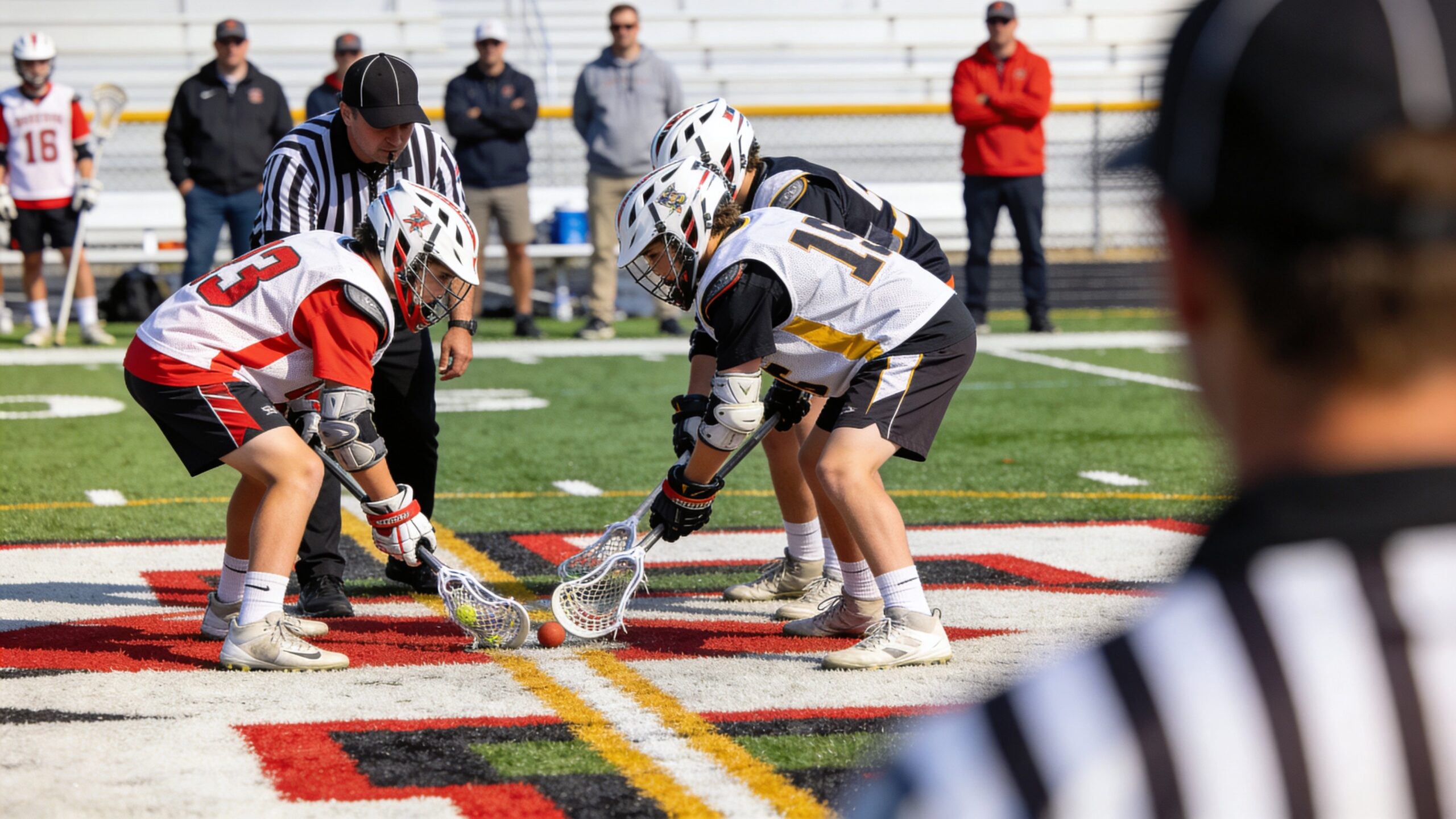
The setup before the whistle is one of the most important parts of a legal youth lacrosse faceoff. Each faceoff player must position the stick properly at the center line, with the ball placed between the heads of the two sticks according to the official’s directions. The sticks must be parallel or aligned as required by the governing rule set for the league, and players must take care not to crowd the ball, clamp early, or gain an unfair edge with improper stick placement.
Body position matters just as much as stick position. Players are usually required to have their gloves and bodies set in legal locations, with their hands properly on the stick and their feet positioned behind the designated line or area. They cannot be leaning into the ball before the whistle, shifting after they are set, or using their body to block before the contest legally begins. Youth officials are especially attentive to movement before the whistle because anticipation is common among younger players. A player who twitches, adjusts, or jumps early may be called for a violation, and possession can be awarded to the other team.
The Referee’s Role in Starting the Faceoff
The referee plays a central role in ensuring every faceoff begins fairly. Before the whistle, the official checks stick placement, player stance, and readiness. If something is incorrect, the official may reset the players and explain what needs to change. In youth lacrosse, this teaching component is especially valuable. Officials are not only enforcing rules; they are also helping young athletes understand how to compete within the structure of the game.
Once both players are set, the referee gives the command sequence and blows the whistle to start play. At that instant, the faceoff specialists may move to gain possession. Timing is everything. A player who reacts legally to the whistle can earn a clean advantage, while a player who jumps early or fails to hold position can cost the team possession. This is one reason faceoffs feel so dramatic. The play lasts only a few seconds, but those seconds demand intense concentration and discipline from everyone involved.
Common Youth Lacrosse Faceoff Violations
Many youth lacrosse faceoff violations happen before the ball is even loose. Early movement is one of the most common issues. If a player flinches, shifts the stick, or moves hands or body before the whistle, the official may award possession to the opposing team. Younger players often struggle with staying perfectly still under pressure, so coaches spend a great deal of practice time teaching patience and control.
Illegal stick positioning is another frequent problem. If the stick head is not aligned correctly, if it touches the ball improperly before the whistle, or if the player fails to meet setup requirements, the faceoff can be ruled illegal before it even begins. Players may also commit violations by using the glove or hand improperly, withholding the ball too long, or trapping it in a way the rules do not allow. In youth games, officials generally want the faceoff to remain a quick contest for possession rather than a prolonged wrestling match with the ball stuck under a stick head.
What Counts as a Legal Move After the Whistle
Once the whistle sounds, the faceoff players may engage in legal techniques to win possession. These usually include clamping, raking, directing, or popping the ball free, depending on the rules of the league and the player’s skill set. What makes a move legal is not just speed, but compliance with the rules governing how the ball is played and how the player uses the stick and body.
A clean faceoff usually involves quick hands, sound balance, and immediate awareness of where the ball goes next. Players can attempt to control the ball with the stick, push it toward a teammate, or scoop it themselves once it becomes available. The best youth faceoff players are not just fast at the whistle. They understand angles, leverage, and timing. They know how to transition from the initial clamp to actual possession, which is where many faceoffs are truly won or lost.
When Possession Is Awarded Instead of Contested
Not every faceoff ends in an active ground-ball battle. In many youth lacrosse situations, the official may simply award possession because of a violation. This usually happens when one player commits a procedural error such as moving early, lining up illegally, or failing to follow the official’s instructions. Instead of restarting the faceoff repeatedly, the rules often allow the referee to give the ball to the opposing team to keep the game moving and reinforce rule compliance.
This system serves an important developmental purpose. It teaches players that discipline matters as much as aggression. A strong athlete with poor control can lose possession before the whistle ever blows, while a technically sound player can help the team simply by following the rules. In youth lacrosse, that lesson is valuable. Players learn that good habits create opportunities, and careless details can immediately swing momentum.
Safety and Sportsmanship at the Faceoff X
Youth lacrosse faceoff rules are not only about fairness. They are also about safety. Because the faceoff brings two players into close contact with explosive movement, leagues and officials place strong emphasis on controlling body position, limiting dangerous actions, and making sure players do not turn the contest into reckless contact. Illegal pushes, dangerous checks, and body contact that exceeds what is allowed can all lead to penalties.
Sportsmanship matters here too. The faceoff is one of the most emotionally charged moments in a game, especially after a goal when momentum feels up for grabs. Young players can become frustrated if they lose several faceoffs in a row or believe an opponent is bending the rules. Coaches and officials help manage this by reinforcing composure, respect, and proper technique. A good faceoff player is not just aggressive. They are calm, disciplined, and able to compete hard without losing control.
How Youth Rules Can Differ From Higher Levels
One of the most important things for parents and developing players to understand is that youth lacrosse faceoff rules may differ from high school, college, or professional lacrosse. Not every league uses the exact same procedures, and some youth organizations modify faceoff rules to emphasize safety, simplify enforcement, or reduce overly specialized play. That means a move seen in a college highlight reel may not be allowed, or may be interpreted differently, in a youth game. Because of this, coaches should always know the rule set their league follows rather than assuming all faceoff rules are universal. Some leagues may have stricter stance requirements, quicker stalling enforcement, or developmental adjustments designed for younger age groups. For players, this means mastering the basics is more important than copying flashy advanced techniques. At the youth level, the player who understands the local rules, reacts cleanly, and plays under control usually has the greatest advantage.
Why Officials Watch the Faceoff So Closely
The faceoff receives intense scrutiny because it can influence the rhythm of an entire game. If one team consistently wins possession at midfield, it can generate more offensive chances, control tempo, and wear down the opponent. Because possession is so valuable, even tiny infractions matter. Officials watch stick placement, hand movement, balance, ball control, and timing because one small illegal action can change the outcome of the play immediately.
For youth players, this can feel frustrating at first. A violation might seem minor, especially when the player is eager to compete. But over time, this strict enforcement teaches an important lesson: details matter. In lacrosse, as in many sports, the small technical habits often separate controlled, effective players from reckless ones. The faceoff becomes a concentrated lesson in precision. It asks players to combine patience, reaction speed, strength, and awareness all at once.
Coaching Young Players to Succeed on Faceoffs
Teaching youth athletes how to handle faceoffs starts with fundamentals, not tricks. Coaches should begin with legal positioning, whistle discipline, and balance. Players need to know where their hands belong, how their stick should be placed, and how to stay relaxed without drifting early. These details create the foundation for every successful faceoff rep. Before a player can dominate possession, they must first prove they can line up correctly every time.
From there, coaching can progress into timing, leverage, and ball awareness. Players should practice reacting to the whistle rather than guessing. They should learn how to direct the ball with purpose, whether to themselves or a wing teammate, and how to recover if the initial move does not work. Youth faceoff development is often less about raw power and more about repetition, confidence, and understanding. A player who knows what the official expects and can repeat clean technique under pressure becomes a major asset to the team.
The Role of Wing Players in Faceoff Success
Although the spotlight usually falls on the two players at midfield, wing players are a major part of faceoff success in youth lacrosse. Once the ball pops free, wing players often determine who truly gains possession. They must time their release correctly, avoid entering too early, and react quickly to the direction of the ball. A faceoff specialist may win the clamp, but without support from alert wing players, possession can still be lost.
This is why coaches treat the faceoff as a team play, not just an individual duel. Wing players need to understand their lanes, communicate clearly, and anticipate where loose balls are likely to go. In youth games, well-coached wings often make a huge difference because ground-ball instincts and hustle can overcome pure technical skill at the X. When everyone understands the rules and responsibilities, the faceoff unit becomes far more reliable.
Misunderstandings Parents and New Players Often Have
One of the biggest misunderstandings about youth lacrosse faceoff rules is the idea that the faster or more aggressive player should always win. In reality, the faceoff is governed by technical rules that reward legal setup, clean reaction, and proper ball play. A player can look stronger and still lose possession by moving early or lining up incorrectly. That can confuse new spectators who see the play only as a physical battle rather than a structured restart.
Another common misunderstanding is that all ties or scrums should be allowed to continue indefinitely. Youth rules typically aim to keep the game flowing and prevent prolonged deadlock situations. If the ball is trapped illegally, withheld too long, or the play becomes unfairly stagnant, the official may intervene. That does not ruin the faceoff. It protects the purpose of the play, which is to restart action fairly and efficiently.
How Mastering Faceoff Rules Improves Overall Lacrosse IQ
Players who truly understand faceoff rules usually become smarter lacrosse players in general. They learn how officials think, how possession is structured, and how technique influences outcomes. The faceoff teaches anticipation, self-control, reaction timing, and situational awareness. Those same qualities matter everywhere else on the field, from ground balls and clears to rides and defensive recoveries.
For young athletes, this makes the faceoff one of the best teaching moments in the sport. It condenses discipline and competition into a few seconds that require total focus. Every whistle offers a new lesson. Every violation reveals something to fix. Every clean win shows how preparation and rules knowledge can create a real edge. When youth players understand not only what the rules are but why they exist, they gain a deeper connection to the game itself.
Final Thoughts on Youth Lacrosse Faceoff Rules
Youth lacrosse faceoff rules may seem highly detailed, but that detail is exactly what makes the play fair, exciting, and developmental. The faceoff is not just a battle for the ball. It is a lesson in composure, positioning, timing, and respect for the structure of the game. For young players, learning faceoff rules early builds skills that pay off far beyond midfield. For parents and coaches, understanding those rules makes the game easier to appreciate and teach. At its best, the youth lacrosse faceoff combines intensity with discipline. It creates one of the sport’s most thrilling moments while still demanding control and sportsmanship. When players learn how to line up correctly, react legally, and compete cleanly, the faceoff becomes more than a restart. It becomes one of the clearest expressions of what youth lacrosse is meant to teach: skill, poise, teamwork, and confidence under pressure.