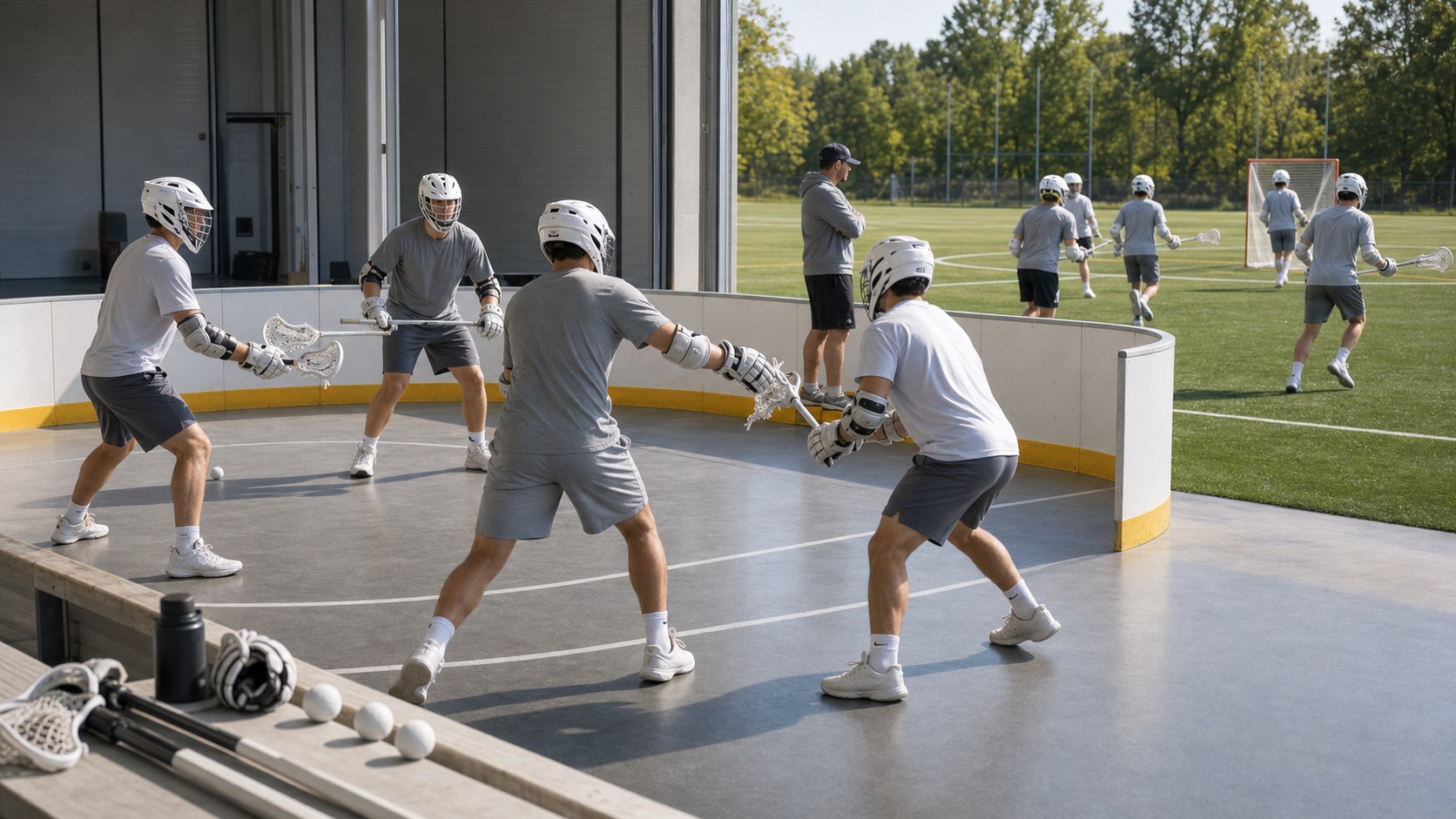
Box Lacrosse vs Field Lacrosse: Which Game Develops Better Skills?
Box lacrosse and field lacrosse develop different skills because they ask players to solve different versions of the same sport. Box compresses the game into tight space, quick decisions, wall pressure, and close-range finishing. Field lacrosse stretches the game across wider spacing, longer runs, clearing patterns, defensive recovery, and team shape. The best answer is not that one game develops better players in every way. The better question is which skill a player needs to grow next, and which format will challenge that skill most honestly.
A: Box often accelerates tight-space stick skills because pressure arrives quickly and repetitions are frequent.
A: Field lacrosse usually teaches wider spacing, longer support, and full-team shape more clearly.
A: Yes, close-range fakes, quick feeds, and traffic finishes can expand a player's outdoor toolkit.
A: Yes, field work can improve running range, transition judgment, and awareness across larger space.
A: Most beginners benefit from good coaching and steady fundamentals before specializing too early.
A: Yes, box teaches leverage and contact balance, while field teaches recovery and open-space support.
A: Calm ball handling under pressure is one of the clearest transfers from box to field.
A: Full-field clearing, riding, and substitution awareness are more field-specific development areas.
A: No, the best format is the one that challenges a useful skill in a safe, coached setting.
A: They should name the skill target, create pressure, and explain how the lesson changes outdoors or indoors.
Better Skills Depends On The Skill
The phrase better skills can be misleading because lacrosse skill is not one thing. A player may have excellent hands but poor spacing. Another may run well in transition but panic near tight contact. Another may shoot hard but struggle to finish through traffic. Box and field lacrosse reveal different gaps, so the better development format depends on the gap being addressed.
Box lacrosse often improves skills that happen in tight windows. Players catch under pressure, pass before traps close, and finish with defenders and goalies nearby. Field lacrosse often improves skills that require a wider view. Players clear through layers, use spacing to create dodging room, and recover defensively across larger areas.
Why Box Builds Fast Hands
Box compresses time. A player who waits for a perfect pass or a wide-open lane may lose possession. This creates a strong training environment for quick hands, short releases, and early decision-making. The player learns to keep the stick protected and useful even when defenders are close enough to bother the gloves.
The boards add another layer. When a ball carrier is pinned, the next useful play may be a short pass, a seal, or a reset rather than a long dodge. That teaches support habits that can help field players near sidelines, creases, and rides. Tight-space skill is not only flashy stick work; it is the ability to remain useful when space disappears.
Indoor finishing can be especially valuable. A player who scores only with time and room may struggle when the goalie is close and the lane is crowded. Box encourages fakes, quick sticks, screens, and rebound awareness. Those tools become valuable outdoors when a field game turns crowded near goal.
Why Field Builds A Wider Game
Field lacrosse gives players more room, but that room has to be organized. Spacing, clearing, riding, substitution, and long recovery are not automatic. A player must understand how one movement affects teammates who may be far away. The wide field develops awareness that box cannot fully duplicate.
Development Is Strongest When Formats Talk
The best players do not treat box and field as rival teachers. They ask what each format is showing them. A box turnover might reveal slow outlet recognition. A field breakdown might reveal poor spacing or conditioning. When players connect those lessons, each format becomes more useful.
Coaches can help by using shared language. A small-area drill can be described as box-style pressure for a field player. A full-field clear can be described as outdoor expansion for a box player. The athlete begins to understand that skill is context-dependent, not format-dependent.
Parents Should Judge Coaching Before Format
Families often ask which version will make their child better, but coaching quality usually matters more than the label. A thoughtful box program teaches safe contact, outlets, and quick decisions. A thoughtful field program teaches spacing, transition, and team shape. A weak program in either format can turn useful pressure into confusion.
Ask what the program emphasizes. Are players getting many touches? Are mistakes explained? Is contact introduced safely? Do drills connect to game situations? Are players encouraged to pass and support, not only score? These answers say more about development than whether the program is indoors or outdoors.
It also matters whether the player enjoys the environment. Development requires repetition, and repetition is easier when the player wants to return. A format that looks ideal on paper may not help if the player feels anxious, ignored, or unclear about expectations.
Skill Transfer Needs Translation
Not every skill transfers automatically. A box player may need reminders to keep proper outdoor spacing. A field player may need reminders to shorten dodges indoors. Translation happens when the coach and player identify the same skill in a new context. Without that step, habits can become mismatched.
For example, quick ball movement is valuable everywhere, but field lacrosse still rewards patience when substitutions or matchups matter. Tight contact confidence is useful, but field defenders still need to recover across more space. Good training explains both the transfer and the adjustment.
The Best Development Plan Uses Both Pressures
A strong development plan uses tight pressure and wide pressure. Tight pressure asks whether a player can keep the ball, pass, and finish when options close. Wide pressure asks whether a player can read space, run, communicate, and make the next team decision. Both pressures are real lacrosse.
How Players Can Self-Assess
Players can compare their own progress by naming specific improvements. Did box help them catch through contact? Did field help them see early outlets? Did indoor finishing add fakes? Did outdoor transition improve conditioning? These questions are more useful than saying one format is better.
A player should also look at weak moments without shame. If the field feels too spread out, practice spacing and support. If box feels too crowded, practice ball protection and faster passing. The format that feels uncomfortable may be revealing the next growth area.
Self-assessment should include teammates. A player who becomes a better outlet, communicator, or defender may be developing even without scoring more. Lacrosse skills show up in team reliability as much as individual highlights.
Avoid The One-Format Trap
The one-format trap is assuming a favorite version teaches everything. It does not. Box may not fully teach long clears or field substitution timing. Field may not fully recreate repeated board pressure or close-range traffic. A complete player benefits from seeing the game from more than one angle.
A Practical Answer For Developing Players
If a player can access both formats with good coaching, both are worth considering. Use box to sharpen tight hands, contact balance, quick decisions, and finishing creativity. Use field to sharpen spacing, endurance, clears, rides, and large-team awareness. The combination creates a broader skill base.
If a player must choose one, choose the environment that best matches the next development need. A player who needs confidence under pressure may lean indoors. A player who needs field IQ and running range may lean outdoors. The right answer is practical, not ideological.
Why The Debate Keeps Coming Back
The debate keeps coming back because both sides have real evidence. Box players often return to field lacrosse with sharper hands and stronger inside confidence. Field players often develop wider awareness and better transition understanding. Each group can point to real success stories.
The most useful conclusion is that skill development is richer than a winner-take-all comparison. Box and field lacrosse are different classrooms. A player who learns from both becomes more adaptable, more composed, and more prepared for the many shapes a lacrosse game can take.
A healthy debate should leave room for level, coaching, and player personality. A first-year player may need confidence before format variety. An advanced player may need the format that exposes a specific weakness. The comparison is most useful when it becomes a question about development goals.
When One Format Exposes A Weakness
A player's least comfortable format can be the most useful teacher. A field player who struggles indoors may discover that the real issue is not bravery but slow outlet recognition. A box player who struggles outdoors may discover that the real issue is not skill but spacing and patience. The format reveals the weakness by changing the conditions around familiar skills.
This can be uncomfortable, especially for confident athletes. A player who usually succeeds may suddenly look ordinary when the game asks different questions. Coaches should frame that discomfort as information. The player is not starting over; the player is learning which habits hold up only in one environment.
The strongest development happens when that weakness becomes a practice target. If tight catches are the issue, shrink the space. If wide-field awareness is the issue, stretch the drill. If defensive recovery is the issue, add a second pass after the slide. The format points to the work.
Players should revisit the weakness after several weeks instead of judging from one practice. Improvement may show up as a cleaner first pass, a calmer carry, or better communication before it shows up as a goal. That kind of progress is easy to miss without a specific target.
Building A Mixed Training Calendar
A mixed training calendar does not have to be complicated. A player might use box in the offseason for tight touches and field in season for tactical structure. Another player might add small-area box-style drills to field practice without joining a full indoor league. The useful idea is pressure variety, not schedule overload.
Recovery and enthusiasm should still matter. Too much lacrosse without rest can turn development into fatigue. Families and coaches should balance touches, games, school, strength work, and downtime. The best plan is one the player can sustain while still wanting to improve.
The Best Skill Is Adaptability
The highest-level skill may be adaptability. A player who can catch indoors, space outdoors, finish through traffic, clear across a field, and communicate in both environments is harder to defend and easier to coach. That player is not dependent on one kind of game.
Adaptability also helps during a single field game. Some possessions feel like box lacrosse near the crease or sideline. Other possessions stretch into wide transition. The player who has trained both pressures can shift without panic. They do not need every situation to look familiar before making a useful play.
So which game develops better skills? The answer depends on the skill, the coach, and the player. Box can sharpen tight execution. Field can sharpen wide awareness. Together, they can give a player a broader and more resilient lacrosse education.
How Coaches Can Use The Comparison
Coaches can make the comparison practical by naming the skill before choosing the drill. If the goal is faster passing under pressure, use tighter space and shorter clocks. If the goal is transition judgment, open the field and force players to read numbers. The format becomes a tool rather than a slogan.
This also helps players understand why practice changes. A cramped drill is not punishment; it is a way to train calm hands. A full-field drill is not just running; it is a way to train recognition and support. Clear purpose keeps players invested in both kinds of work.
A Player Development Checklist
Players can use a simple checklist after each season. Did my catching improve under pressure? Did I make faster outlet decisions? Did I understand spacing better? Did I defend with better body position? Did I handle transition without rushing? These questions reveal which format helped and what still needs work.
The checklist should include team habits too. A player who becomes a better communicator, safer defender, or more reliable ground-ball option has developed meaningful skill. Lacrosse growth is not only about scoring more goals or winning more one-on-one matchups.
The best answer to the development debate may change over time. One season, a player may need box pressure. Another season, the player may need field spacing. Smart development follows the player, not a fixed argument.